Early Objective Setup: Why Drakes and Grubs Are Won Before You Start Them
One of the most common bad patterns I see in my clients is bad objective setup. To be more precise, it's starting objectives on bad timers, which leads to bad fights and eventually to losing the lead, or giving the enemy a lead so big that the game feels out of control.
In my last video, I showed good timers for starting objectives, what they mean and how to look for them in your own games. In this blog, I'm going to explain the theory behind it and give real-game examples of how to apply it.
The Blueprint
- Wave states & prio – identifying which lanes you can play towards
- The enemy jungler – this is where jungle tracking comes into play
- Your own timers – camps, level, cooldowns and tempo
Let's break it down one by one.
Wave States
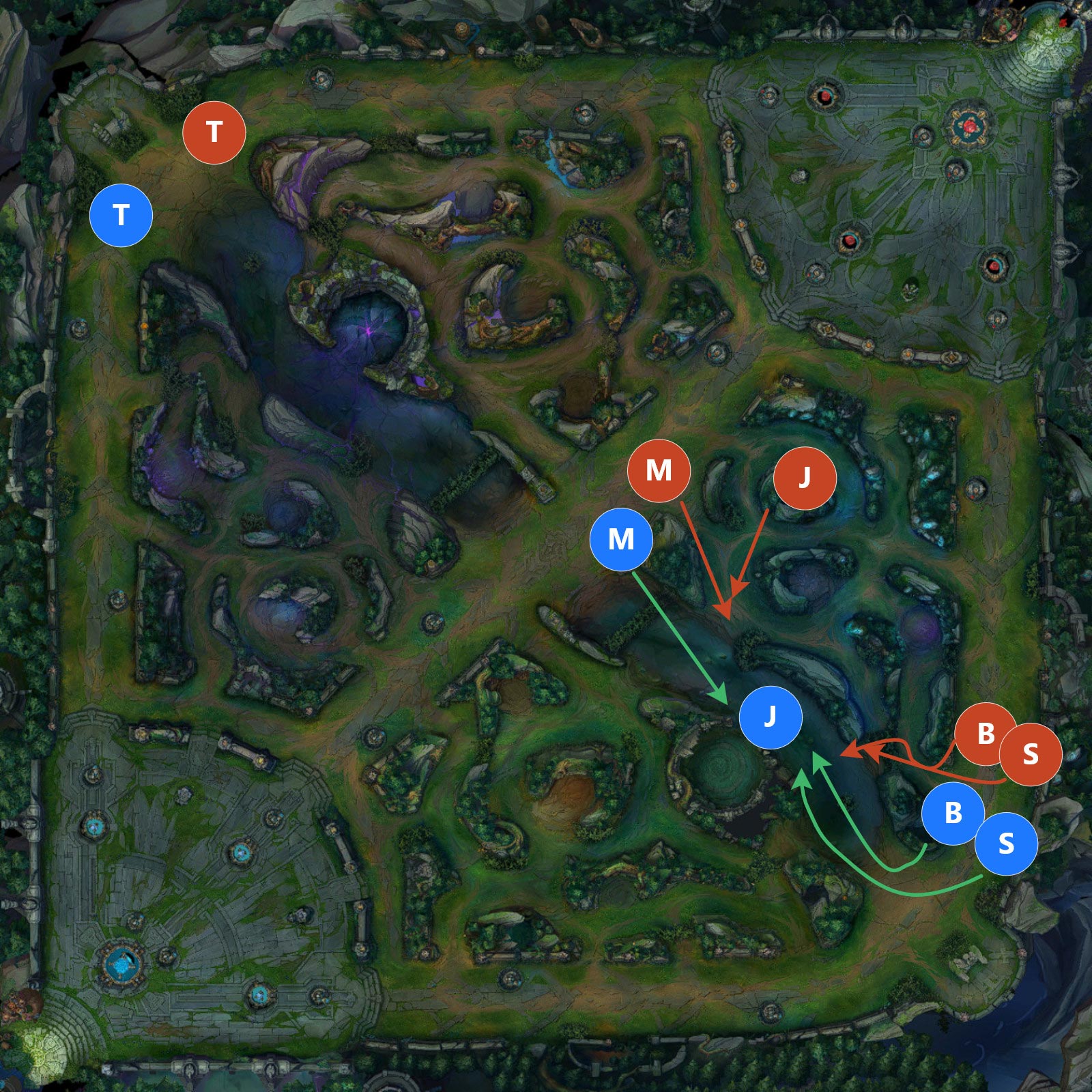
To keep it simple: if your laners shove the wave into the enemy tower first, they are the ones who can move first. This is one of the most important parts of objective setup. Starting an objective when both lanes closest to it have prio (for Dragon, that's Mid and Bot lane) is a great move. In this scenario, the Mid laner and the Bot laners have all pushed their waves into the towers and are ready to move. This is important because the enemy laners now not only have to deal with the wave crashed into their tower, but also have to walk past your laners.
It's always harder to contest an objective if you are the second team entering the area.
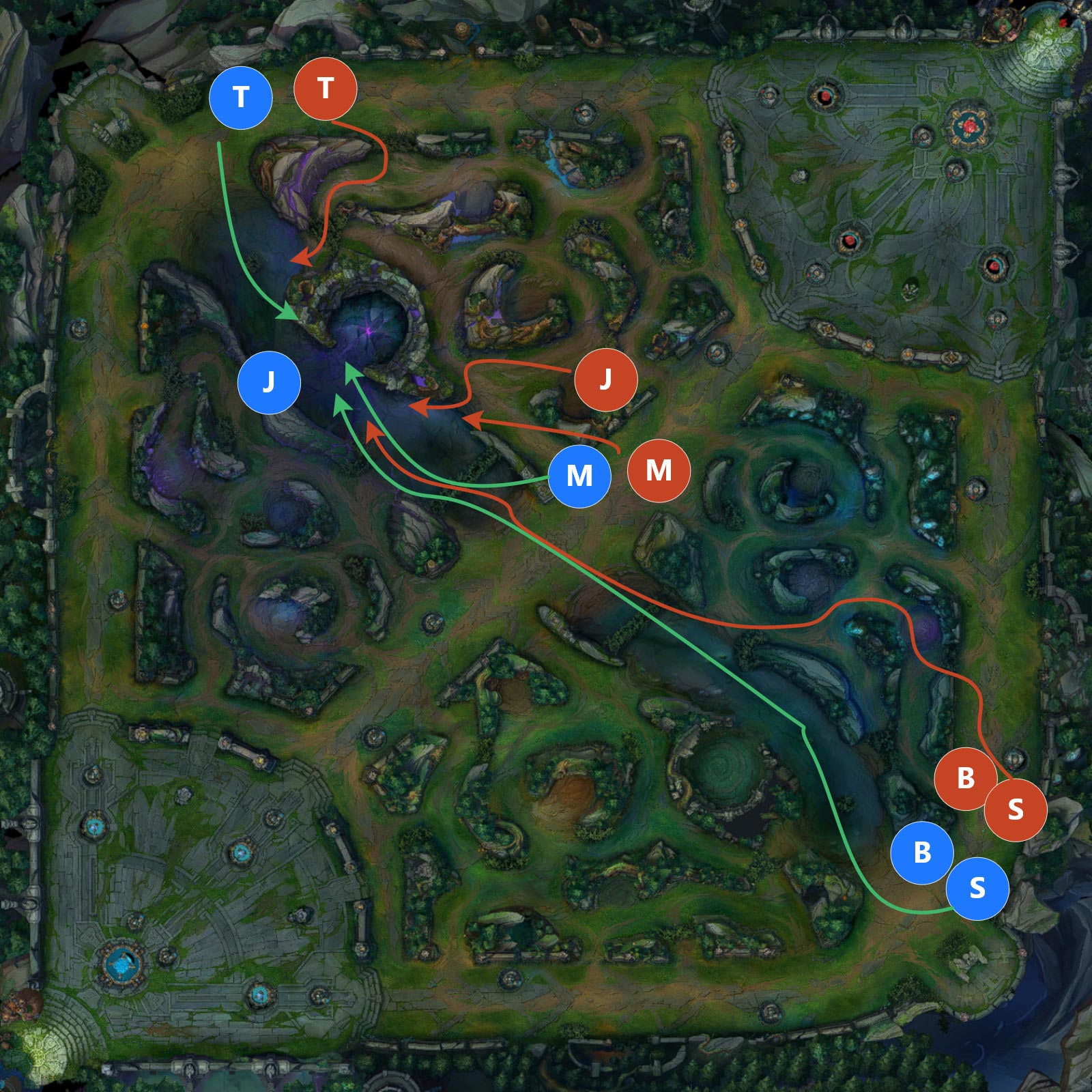
The same rules apply to objectives on the other side of the map, except now it's Top lane and Mid lane that matter, with the Support as an optional "joker" who can decide to move. In really high elos you might also see ADCs move, but for the sake of simplicity, let's say they don't.
Your Top laner and Mid laner can move first and hold positions in the river, making it hard for the enemy laners and jungler to walk in and contest the objective. More on how to play these scenarios later in the article.
Lane Priority
This is a tough one (khm khm, Crownie and Velja), but let me try to explain it in the simplest way possible.
The player with lane priority is the one who can make the first move towards a certain play. This is very conditional, so we need to understand everything that has to be taken into account:
- Wave state – As we already talked about, this one is also conditional. Some players will drop an entire wave and let it die to the tower if they think being on time will grant them bigger rewards. But as a general rule of thumb, if you shoved the wave first, you are the one with prio.
- Resources – Health and mana bars are extremely important and often forgotten about, especially mana. Even in situations where your laners are the first ones to shove the wave, if they have no mana and no health while the enemy laners are fresh off a reset, your laners still have prio to move first, but the enemy has better conditions to fight and can brute force through them to get to the objective. All in all, you want your laners to shove the wave and have a healthy amount of HP and mana.
- Cooldowns – The third thing that matters: who has ult? Who has Flash? Do you even have your Smite available? This condition is the most complicated one to answer in a vacuum, as Flash doesn't have the same value on every champion at every moment of the game, and neither do ultimates. But it's an important thing to keep in mind. Imagine your Mid laner and both Bot laners used their ults 40 seconds ago to get a single kill on the enemy jungler, who just respawned in time for Dragon. The entire enemy team has their ults now and can make it to Dragon on time, while your team doesn't. Now it's a big deal and something to look out for.
- Vision – Even though it's important, in my opinion it matters less in the early game, when laners are expected to be around their lanes and it's not as hard to predict where the enemies will come from. It becomes more important in the later stages of the game, when towers fall and laners have more free time to run around out of vision.
The Enemy Jungler
In most games, both junglers path to bot lane, meaning that if everything goes according to the standard game plan, both of them will be bot side for the first Dragon spawn. In that situation, a few things come into play:
-
Wave states and lane priority – that's why they're among the most important factors for early objectives.
-
Levels – If one jungler invaded the other, stole one of his camps and completed his own second clear without skipping a camp, he will either be level 6 or a few minions' worth of XP away from it. This gives him a huge edge over his opponent. It can also happen in niche situations where he got solo kill XP and took some waves, but that doesn't happen as often.
-
Smite – Having a 600-damage Smite or a 1000-damage Smite is a big deal. It's a more than 50% damage increase, and against low-damage spells on first drake, it's basically a guarantee of smiting the Dragon. This also matters because a jungler will often level up to 6 from the Dragon execute, allowing him to keep fighting with an advantage.
Getting your Smite to 1000 damage before the first Dragon happens in three ways:
- Double crab – You take both crabs over the enemy jungler and get two full clears off, getting you to 20 treats.
- Invade – You take one of his camps, most often his Raptors. In this scenario, you only need one crab.
- The 5:30 Smite trick – You get an additional treat at 5:30. If you delay the last camp of your clear (Krugs or Gromp) and kill it after 5:30, you get the extra treat, which lets you reach a 1000-damage Smite with only one crab.
All three of these factors will come in handy when assessing whether starting the objective is a good or a bad play.
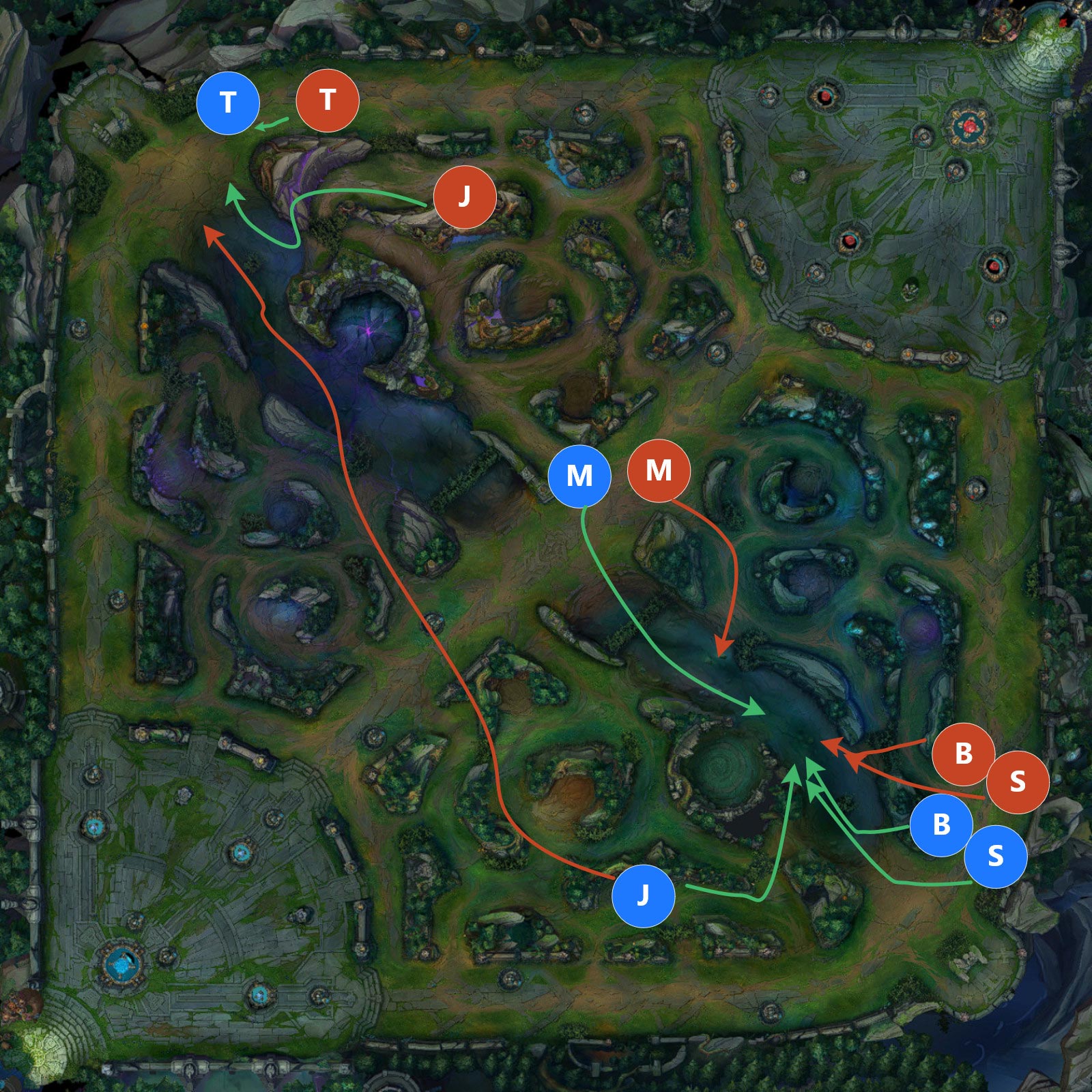
Not as often, but still in a decent number of games, you will "mismatch" the enemy jungler: he paths top, you path bot. In this scenario, you're often "free" to start the objective if the other conditions we talked about are met. There are only two things you need to worry about now:
- Can the enemy jungler recall and be on time, and what will the lanes look like by then? Will the waves bounce and give the enemy laners prio, or are your laners strong enough to keep the push? Or in some cases, like when you're playing a level 6 Kha'Zix, can you just one-shot the drake before anyone can even come?
- What will the enemy jungler do?
- Gank top lane – Now your job is to prevent it. The only way to do that while getting the objective is to spam ping your Top laner to back off.
- Play for your buff respawn – Your first buffs respawn around the time you finish the Dragon and recall. As you're walking into the area of the buff, the enemy jungler can already be there. Oftentimes you can call your Support to help you out with this.
Your Own Timers
I've talked about how important it is for your laners to be able to move first and, if they can, to be ready to fight in good condition: health, mana and cooldowns. I've also covered how level 6 and Smite affect fights in the early game. There are a few more things to consider as a jungler before you look for an objective:
- Are my camps up? How many of them? Skipping an entire clear just to start an objective, even if you secure it, is never worth it. This can be done later in the game, when the objective is Baron or Dragon Soul, but in the early game, getting the first Dragon at the cost of 4 or 5 camps is never worth it. It will snowball the game in the enemy's favor, gold- and XP-wise, and you will miss out on every objective after it simply because you're weak. There are certain scenarios where skipping one or two camps is completely fine though, and I'll cover them below.
- Tempo – Will the objective completely screw up my tempo and make me lose a lot of resources later? The first scenario that comes to mind, and it happens in a lot of games, is a fight after the second clear. You just finished the last camp of your second clear and walked into the enemy bot lane for a gank. The enemy jungler is there as well, and the fight lasts an entire minute, back and forth. Ultimately you end up winning it, and naturally you think of starting the first Dragon. But here's the thing: if you do this, your camps have already respawned, and the enemy jungler will walk out of base, go straight to your top side, take it and create a level and gold advantage. Now your won fight before Dragon doesn't matter! The rule is: do objectives when you don't have to be anywhere else for the next 30-ish seconds.
Skipping Camps for an Objective
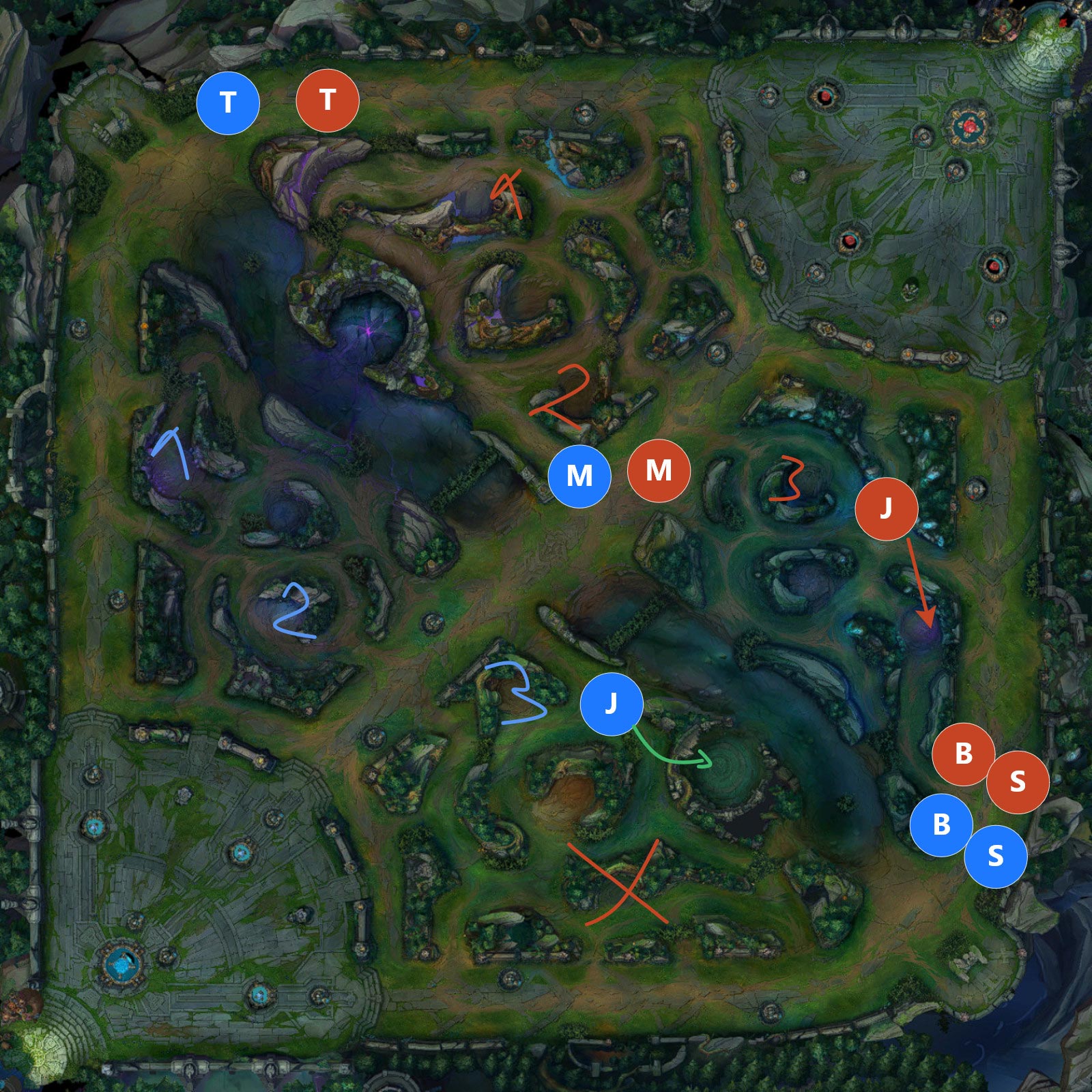
This is one of the most common situations where skipping a single camp to secure an objective is good. You're the blue-side jungler and you've just finished your Gromp, Wolves and Raptors. Instead of going for Krugs, you immediately start the Dragon. This works best with junglers that can jump over the wall, as you're almost certainly dodging all of the enemy's vision.
When should you do this?
- If your Bot lane and Mid lane have prio right as you finish Raptors.
- If the enemy jungler had a delay starting his second clear. That means he won't be finishing Wolves at this moment; he'll either be finishing Raptors or starting Wolves, so he still has two camps to clear before he can go to Drake. That gives you enough time to solo it before he comes.
Doing this is also a bonus if your first clear was Raptors → Red → Krugs, because instead of waiting 10 seconds for Krugs to spawn, you're effectively using that time to do the Dragon. Afterwards, you can do Krugs, recall and still be on time for the Gromp respawn.
The Advantage of Being First
There's one more thing left to cover. We talked about how important it is for laners to be first and able to move towards the objective: you simply have a shorter distance to walk, and you can deny the opponent's entrance. But still, I've seen a lot of players start objectives on correct timers and completely misplay the opportunity.
Oftentimes you'll find yourself in a position like this: you're tanking the Dragon, your team is around you, they actually came first, and the enemy cleared the wave and started moving. They're very close, and you start to panic because they're collapsing from all sides. But that's exactly what makes them weak. When defending the objective, you need to think about these two things:
- Objective HP – Can you finish it before the enemy even has the opportunity to engage? If the answer is yes, just burst it and then look to fight. Even if the fight goes wrong, you've already gained something. You might also hit level 6 from the Dragon, making you stronger for the fight. If the objective is still very healthy, chances are you didn't start it on time or you hesitated, but don't worry, there's still a way out.
- Enemies – Who from the enemy team is stepping up, and how? In this image, Mid and Jungle are coming from the banana bush, while the Support and ADC are stepping up from the tri-bush. This means that if you quickly engage on one side, you'll move away from at least two of them, creating a temporary 4v2, which in theory should be winning if all the conditions we talked about earlier are met. This is how you should approach turns: quickly analyze who walked up, who you can one-shot, who the important target is and where you can create a numbers advantage the easiest.
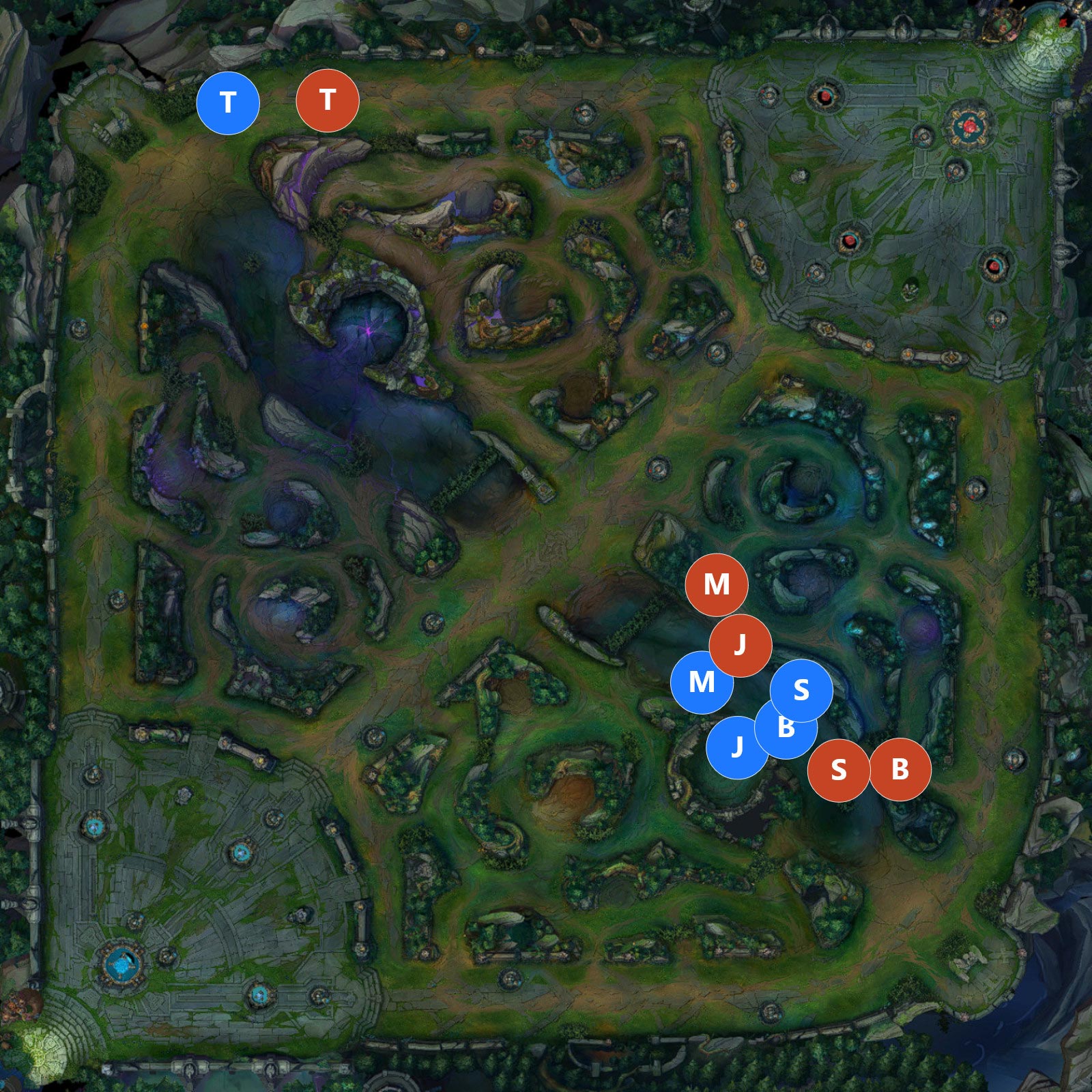
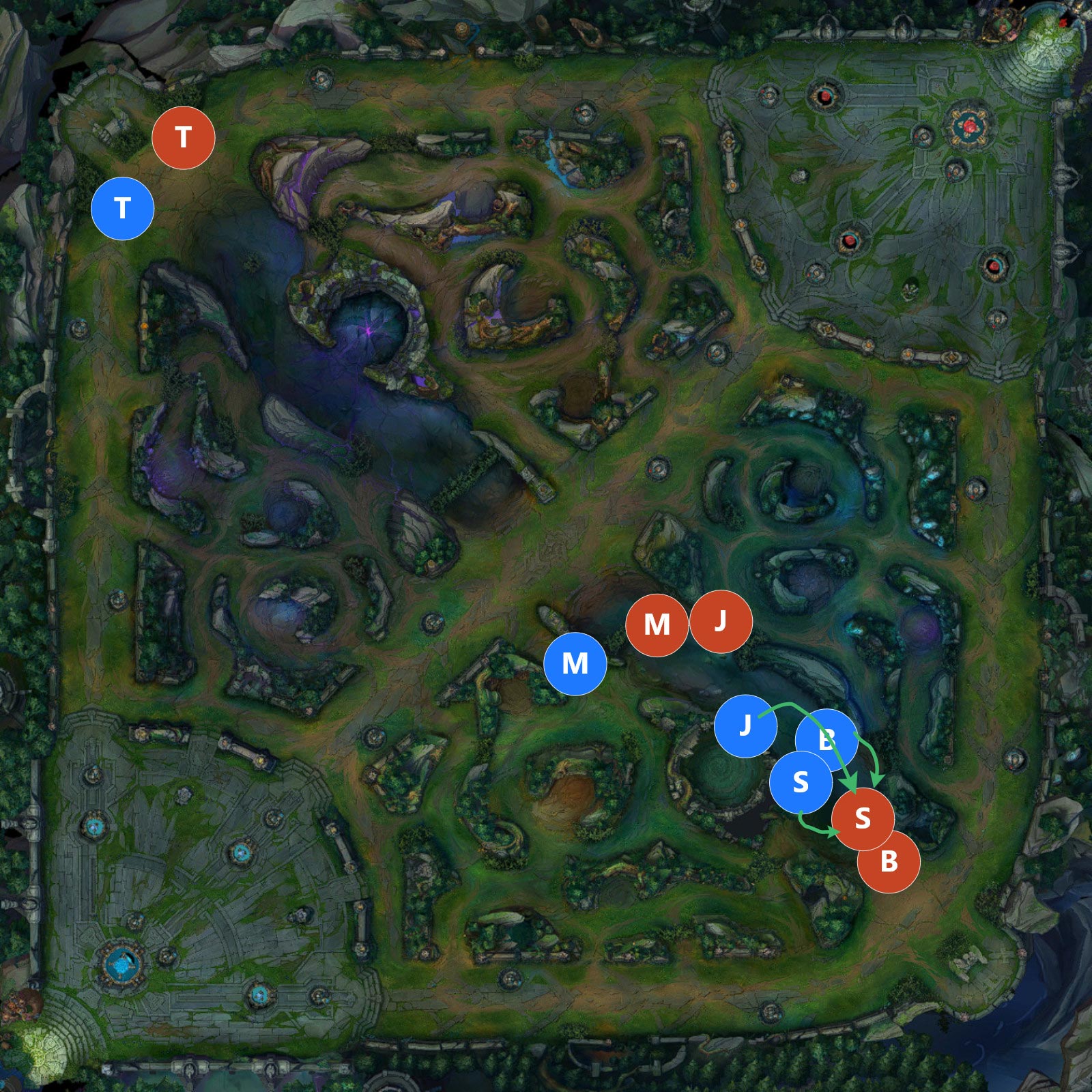
With these tricks, even when you don't make the perfect objective call (for example, when the enemy Mid laner has first move instead of yours, like in the image below), you can still drag the fight towards your Bot lane and make it a temporary 3v2, which is still winning if all the other conditions are met.
Conclusion
League of Legends is a unique game in the sense that, even though it has game theory like chess, no two games are the same. Even if fights were replayed, they wouldn't play out the same way.
There are perfect scenarios in which you should start objectives, but in reality they won't happen in your games that often. What will happen are imperfect scenarios. Maybe only one side has prio and the other doesn't. Maybe you don't have your ultimate up and the enemy jungler does, but on the other hand, the enemy Mid laner doesn't and yours does.
That's why understanding these conditions is crucial. It allows you to maximize the chance of your play working and, if possible, minimize the side effects of it failing. Done consistently over a game, this will more often lead to victory than defeat, allowing you to climb.
Thank you for reading my article, and I hope you enjoyed it! If you want to see these concepts applied live and ask me questions while I play, come hang out on stream: twitch.tv/bart1n_lol